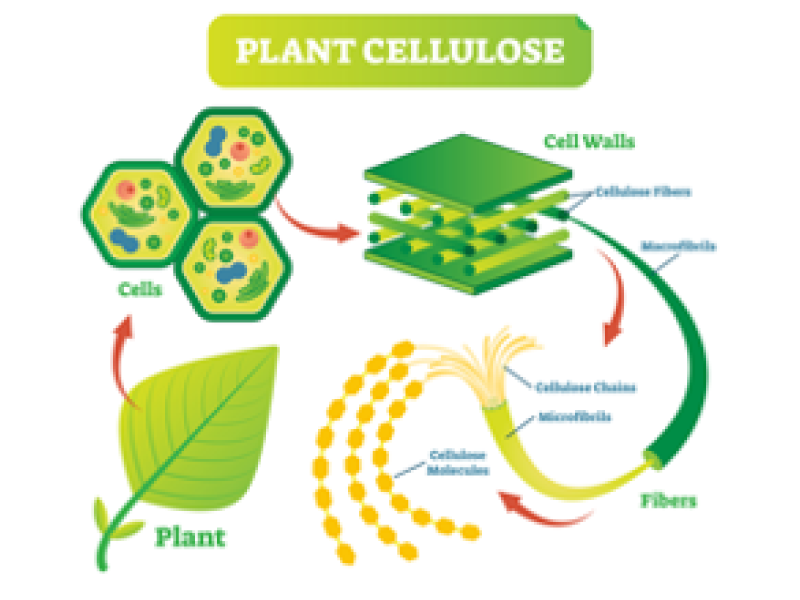
LiMC² explores the potential of naturally-sourced materials such as cellulose (from plants), chitin (from crustacean shells and fungi), and mycelium (the root network of fungi) to advance sustainable, multifunctional systems. These abundant and renewable biopolymers offer unique structural, mechanical, and responsive properties that can be engineered for applications ranging from lightweight composites and smart coatings to biomedical devices and environmental solutions.
Among these, cellulose and mycelium-based composites have attracted particular attention as sustainable alternatives that can be produced using low-energy bio-fabrication processes and renewable feedstocks. Cellulose, the most abundant biopolymer on Earth, offers remarkable strength-to-weight ratios and tunable architectures, while mycelium composites are grown by upcycling agricultural byproducts and waste. Applications span construction, packaging, and consumer products. Yet, challenges remain: fungi release CO₂ as they grow, and the environmental cost of this process has not been fully assessed; similarly, the circularity of both cellulose- and mycelium-based systems is not yet holistically understood. In addition, both materials are highly sensitive to parameters such as source feedstock, species or cultivar, processing, and growth conditions, which leads to fragmented documentation and inconsistencies in performance.
To realize the full promise of naturally-sourced biomaterials, LiMC² integrates biology, engineering, ecology, and social science to address these challenges. By coupling unconventional living materials with innovative science, we aim to design bio-inspired pathways that not only mimic nature’s efficiency but also meet ambitious goals of carbon neutrality, resilience, and sustainability in the built environment.
3D-DIC Quantified Shape-Change for 4D Printing of Mycelium-Based Architectural Panels
This project proposes to develop 4D printing protocols for mycelium-based composites by controlling and quantifying shrinkage-induced shape-change with 3D digital image correlation, enabling simplified fabrication of non-planar architectural panels through a new Penn State-Freiburg collaboration.
Principal Investigators
Benay Gursoy
Penn State
Chris Eberl
University of Freiburg
HYBRID PLANT: Plant-inspired Hybrid Robots for Reforestation
This project proposes to develop plant-inspired hybrid microfabricated robots that integrate natural seed structures with biodegradable materials to deliver nutrients or seeds into soil, enabling targeted cargo release for precision agriculture and reforestation.